The Real James Herriot: The Man Behind Darrowby, from Thirsk to the Dales
If you know James Herriot from All Creatures Great and Small, you may picture a vet crossing the Yorkshire Dales to visit a farm, whatever the weather. Those stories feel rooted in a real place because they were shaped by a real working life.
But James Herriot was a pen name. The man behind it was Alf Wight: a veterinary surgeon who made his home and built his career in Thirsk, and whose experiences inspired the fictional Darrowby.
Who was the real James Herriot?
James Alfred Wight, known to friends and family as Alf, was born in Sunderland in 1916. He moved to Glasgow with his parents when he was an infant and grew up there. After training as a vet at Glasgow Veterinary College, he qualified in 1939.
In 1940, he came to North Yorkshire to work at a veterinary practice in Thirsk. He stayed in the area for nearly 50 years, caring for animals and making calls across the surrounding countryside. The work took him out to farms and into the lives of the people he later wrote about.
That day-to-day experience matters. The books are funny and warm, but they are also rooted in the practical demands of country veterinary work: long journeys, difficult cases and the people who depended on the local vet.
Why did Alf Wight write as James Herriot?
Wight’s wife, Joan, encouraged him to write. He drew on his work and the people around him, turning the realities of life as a country vet into stories for readers.
He chose the name James Herriot partly to keep some professional reserve. There were also rules at the time about vets advertising. The pen name gave him a way to publish without simply putting his practice’s name on the books.
His real colleagues inspired some of the characters, too. Donald Sinclair and his brother Brian are widely recognised as models for Siegfried and Tristan Farnon. Wight’s son Jim followed his father into veterinary practice and later wrote about his life in The Real James Herriot.
What books did James Herriot write?
The stories first appeared in books including If Only They Could Talk and It Shouldn’t Happen to a Vet. In the United States, the first two books were combined and published as All Creatures Great and Small. A title that became familiar to readers and television audiences around the world.
The books sold in their millions. Their appeal is easy to understand: they bring together animals, the ups and downs of rural work, and the relationships between neighbours. They also offer an affectionate view of a part of Yorkshire that can still feel far removed from city life.
Is Darrowby a real place? What is James Herriot’s birthplace?
Darrowby is fictional. The real town behind much of its inspiration is Thirsk, where Wight worked and lived. His home and veterinary practice stood at 23 Kirkgate. Today, the building is The World of James Herriot, a museum where visitors can explore the place connected with his working life and the books.
It is worth separating two places that are easily muddled. James Herriot’s birthplace was Sunderland. Thirsk was where he established his veterinary career; it was not where he was born. Glasgow, meanwhile, was where he grew up and trained.
If the museum is the main reason for your visit, give Thirsk its own place in your plans. You can check visitor information with the museum before travelling.
Where was All Creatures Great and Small filmed?
There are two well-known television versions, and their Darrowbys are in different Yorkshire Dales villages.
The original BBC series, which ran from 1978 to 1990, starred Christopher Timothy as Herriot and Robert Hardy as Siegfried. It filmed largely around Askrigg in Wensleydale, which stood in for Darrowby.
The newer Channel 5 adaptation, first broadcast in 2020, stars Nicholas Ralph as Herriot and Samuel West as Siegfried. For this version, Grassington in Wharfedale became Darrowby. The production also used Dales landscapes as part of the world around the fictional town.
So if you’re looking up All Creatures Great and Small filming locations, it helps to check which series you mean: Askrigg for the original BBC version, Grassington for the newer series. Neither village is the real town where Alf Wight practised.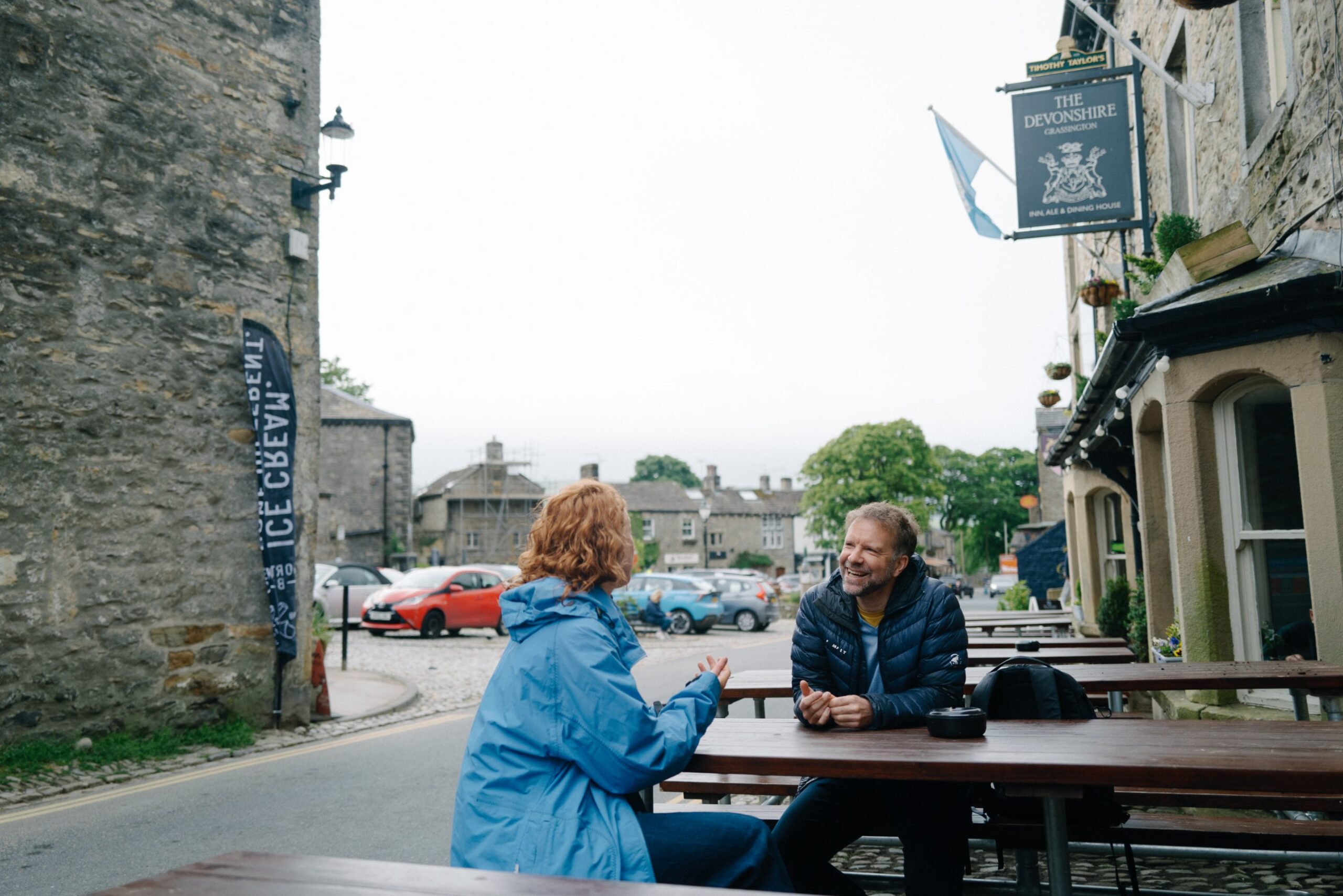
Photo: Tom Arber, courtesy of Visit York
What does the Dales countryside add to the stories?
The countryside is more than a backdrop. It helps explain the shape of a country vet’s working day: farms are spread across valleys, and travelling between them means following the roads and lanes that link one community to another.
Wensleydale and Wharfedale offer different views of that landscape, with villages, working farms and open countryside. You don’t need to know every scene from the television series to enjoy being there. The appeal is often in the ordinary details: a stone-built village, a quiet stretch of road, or a view opening up as you travel through a valley.
Can you visit James Herriot country from York?
Yes, but it helps to choose which part matters most to you. Thirsk, Grassington and Askrigg are not the same stop, and trying to fit all of them into one day from York could leave too little time to enjoy any of them properly.
Our eight-hour Yorkshire Dales, Falls & Market Towns tour includes Grassington, the village used as Darrowby in the newer series. The route also takes in Bolton Abbey, Burnsall, Linton Falls and Brimham Rocks, with the order and pace adjusted sensibly as the day unfolds. It costs £395 for a private group of up to four. Lunch and any attraction admission are separate.
If your interest is the classic BBC series and Wensleydale, our nine-hour Wild Yorkshire Dales tour travels through that wider area, with stops at Bolton Castle, Aysgarth Falls, Hawes and Ribblehead Viaduct. It costs £489 for your private group of up to four. Bolton Castle admission, food and drink are not included.
Neither is a dedicated James Herriot locations tour, and neither includes the museum in Thirsk. The first gives you time in Grassington; the second explores Wensleydale, near the area associated with the original series. If 23 Kirkgate is top of your list, Thirsk is readily reachable from York, and we can talk through what makes sense for your day.
I’ve lived in York for over 25 years, and I know visitors often want to see more than one place without spending the whole day working out roads, connections and timings. A private tour can make that easier, but the right plan depends on what you most want to see.
You can compare our tours and ask about your plans. Tell me whether it’s the books, the BBC series, the newer Darrowby or the real practice in Thirsk that interests you most, and we can start there.
All the best,
Kes